SCIENCE & HISTORY
Yes, Europeans Ate Mummies: The Strange History of Mumia
For centuries, Europeans swallowed powdered mummies as medicine. The history of mumia reveals a trade in human remains, counterfeit cures and enduring misconceptions.
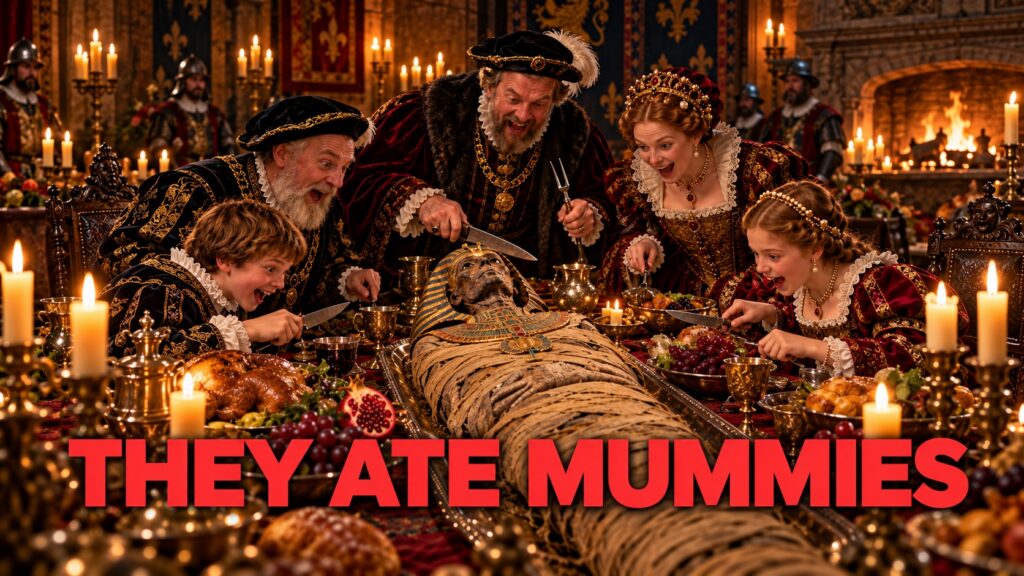
Watch: They Ate Mummies
WKE News explores the strange history of mumia. 3 min 26 sec.
Episode context: The video’s phrase “they ate them all” overstates what historians can establish. Demand, restricted supplies and counterfeiting are documented; consumption of all or most Egyptian mummies is not. The evidence and distinctions are explained below.
Long before mummies became familiar movie monsters, parts of them ended up in European medicine cabinets. People swallowed preparations made from preserved human remains because they believed the dead could help heal the living.
Yes, Europeans really did consume mummies. The surprising part is how ordinary the transaction could become: an ingredient bought from an apothecary, prescribed for an injury, or included in a household remedy. The name on the medicine was mumia, also spelled mummia.
The Royal College of Physicians’ historical collections place mummy preparations among medical commodities used from the 12th through the 18th centuries. That does not mean every European took them. It means the practice belonged to a recognizable medical tradition, with recipes, suppliers and customers.
What was mumia?
The story begins with a substance, and a word, whose meaning changed.
Mumia was associated with naturally occurring bitumen, a dark, tar-like material credited with medicinal properties. The dark substances found on Egyptian mummies became entangled with that reputation. Over time, the name and the supposed healing power extended to the preserved bodies themselves.
As historian Caroline Tully explains in the University of Melbourne’s account, mummies were harvested for both their dried resinous material and their flesh. By the 16th century, mummy had become a valuable drug exported to Western Europe, where it was powdered, swallowed or applied to wounds.
This was more complicated than a single translation mistake that fooled an entire continent. The historical name could refer to different substances. A modern scholarly history of early modern medicines describes its shifting meanings: mineral material, preserved flesh and substances associated with corpses. Reading “mumia” in an old recipe does not automatically tell us exactly what was in the jar.
Medicine, rather than the dinner-table scene
The cover’s banquet is a visual exaggeration. The documented story concerns remedies made from human remains, including powders and tinctures. It is not evidence that European families routinely carved whole mummies at dinner.
The intended treatment depended on the preparation. Mummy-based medicines were associated especially with bleeding and injuries. Some were swallowed; others were used externally. Sarah Wigges’ recipe book, preserved by the Royal College of Physicians, includes “outlandish mummie” in a plaster for wounds and ulcers, alongside oils, wax and aromatic ingredients. That particular recipe documents a topical treatment, not a meal.
The distinction makes the history more unsettling in its own way. A dead person’s remains could be made socially acceptable by grinding them down, mixing them with familiar ingredients and presenting the result as a remedy.
Why did people believe it worked?
Mummy medicine fitted into a wider tradition often called medicinal cannibalism or corpse medicine. Human skull, blood and fat also appeared in treatments, though those ingredients did not necessarily come from Egyptian mummies.
Historians Louise Noble and Richard Sugg, interviewed by Smithsonian Magazine, describe ideas in which bodily substances retained vitality or could treat a corresponding part of a living body. Within those systems of belief, a human ingredient could be considered potent precisely because it came from a person.
That explains the reasoning. It does not establish that powdered mummy could cure disease. Historical prescriptions show what people believed and administered; they are not clinical proof that the treatment worked.
The market for counterfeit mummies
A medicinal trade required a supply of bodies. When genuine Egyptian mummies became difficult to obtain, suppliers had an incentive to offer substitutes.
One often-cited account concerns Guy de la Fontaine, a physician who visited Alexandria in 1564. As recounted in the University of Southern Queensland’s historical overview, he encountered supposed ancient mummies manufactured from recently dead people.
The account also appears in Warren R. Dawson’s 1927 study, “Mummy as a Drug,” which traces the story through the surgeon Ambroise Paré. It should be read as a reported historical encounter, not a modern inspection report establishing the composition of every shipment.
Nor was every newer body simply an undisclosed fake. Some medical writers advocated preparations made from recently dead people. “Mummy” had become a category flexible enough to accommodate ingredients far removed from ancient Egypt.
Did Europeans eat so many mummies that they ran out?
The evidence supports a narrower, still remarkable conclusion: demand helped create supply pressures and a market for counterfeit mummy medicine. Dawson also describes restrictions on the trade as a complication in obtaining bodies.
It does not follow that Europeans consumed all, or most, of Egypt’s mummies. The sources cited here provide no reliable total for the number eaten, and difficulty supplying a commercial market is different from exhausting an entire archaeological resource.
There is physical evidence behind the trade, too. A chemical study of residue in an 18th-century vessel labelled MUMIA identified materials consistent with mummified remains and embalming, including degraded tissue, resins, wax and asphalt. One vessel cannot measure the whole trade, but it shows why the history is more than a collection of lurid anecdotes.
Some doctors objected at the time
Disbelief is not exclusively a modern reaction. In Dawson’s account, the 16th-century surgeon Ambroise Paré challenged mummy medicine’s usefulness and described unpleasant effects, including stomach trouble and vomiting. His objections also concerned how little buyers and prescribers knew about the substance’s origins.
The practice nevertheless persisted. Smithsonian’s survey describes a broader decline in corpse remedies during the 18th century, alongside much later surviving examples. There was no single moment when Europe collectively stopped, and the historical record does not justify explaining the decline solely as “they ran out.”
The person behind the powder
The most disturbing transformation was from human remains into merchandise. Once the body became a powdered ingredient, its identity and burial could disappear from the buyer’s view. What mattered at the counter was the remedy’s reputation.
A body preserved for centuries could end up crushed into a drug sold by weight. That is the history behind the startling sentence “Europeans ate mummies”: a trade that made consuming the dead seem, to its customers, like taking care of the living.
DOCUMENTATION
SOURCES & RECEIPTS
Sources checked October 25, 2026. Links open in a new tab; some publishers restrict access.
- Royal College of Physicians: The Body as Medicinesurviving household recipes, including Sarah Wigges’ mummy plaster.VIEW SOURCE →
- Caroline Tully, University of Melbourne: A Chance to Unwrap the Mystery Around Mummiesthe medicinal trade and changing uses of mummified remains.VIEW SOURCE →
- “The Problems of the Flesh,” in Mixing Medicinesthe different substances described as mumia.VIEW SOURCE →
- University of Southern Queensland: Why Did People Start Eating Egyptian Mummies?medicinal demand and the reported 1564 encounter with counterfeit supplies.VIEW SOURCE →
- Warren R. Dawson: Mummy as a Drug (1927)historical texts, trade restrictions and Paré’s objections. This older study’s claim that bitumen was never used in embalming should not be treated as current scientific consensus.VIEW SOURCE →
- An 18th Century Medication “Mumia Vera Aegyptica” — Fake or Authentic?chemical analysis of material preserved in a pharmacy vessel.VIEW SOURCE →
- Maria Dolan, Smithsonian Magazine: The Gruesome History of Eating Corpses as Medicineinterviews with historians about beliefs, the broader practice and its decline.VIEW SOURCE →
Historical explainer by WKE News, published October 25, 2026. Medical claims described above are historical beliefs. The accompanying artwork is an editorial illustration.